Teaching with Dickens Notes
How to cite this page (MLA): Gibson, Anna. “Teaching with Dickens Notes.” Dickens Notes. Anna Gibson and Adam Grener, dirs. 2026. Web. http://dickensnotes.org/usage/teaching/
Assignments and Activities
This section of Dickens Notes features assignments and activities from instructors who have taught with attention to Dickens’s working notes and serial practice. Each practical assignment or activity is introduced by a short essay providing a critical framework for its pedagogical approach.
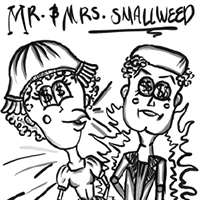
ASSIGNMENT: Responding to Serial Narratives Over Time
Kirsten Andersen
Students engage with serial narratives in this semester-long assignment with creative, critical, and contextual responses.
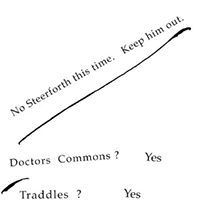
ACTIVITY: Identifying Character-Spaces
Michael J. Flynn
The working notes for David Copperfield help students grasp Alex Woloch’s concept of “character-spaces” in this classroom activity.
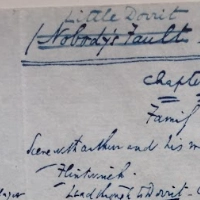
ASSIGNMENT: Annotating the Working Notes
Anna Gibson
This assignment guides students to select a single installment, annotate its respective working note, and develop an essay to synthesize their insights.
ASSIGNMENT: Keeping “Reading Notes” for a Novel
Adam Grener
This assignment provides students with a format for keeping “reading notes” that document and analyze each serial installment of a novel.
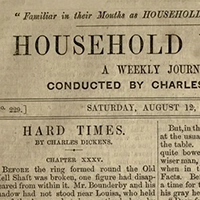
ASSIGNMENT: Examining a Weekly Serial Part
Nikki Hessell
In this short assignment, students examine a weekly serial installment to reflect on the relationship between literature and journalism.
Do you teach with Dickens’s working notes? Submit your activity or assignment with an accompanying short essay for consideration at dickensnotes@gmail.com.
Why Teach with Dickens Notes?
Given their unwieldy length, Dickens novels can present unique challenges in the classroom. Students often struggle to keep track of vast character networks, multiple narrative threads, and the complexities of serial form. The working notes offer a unique means of addressing and accessing this textual complexity. In as little as 19 pages they can function as an index to the form and content of an 800-page text. Incorporated into formal assignments or used as a reference point for discussions, they help students grasp Dickens’s compositional practice, the constraints and affordances of serial form, and the movement of plot and character over multiple installments.
Recent scholarship on teaching Victorian literature has championed approaches that help students experience what it meant to be a Victorian reader or writer of serial fiction. While some instructors simulate Victorian serial consumption via the serial assignment of reading across the course of a semester (Tange), others experiment with having students become part of reading communities (Cook and Henley), or imagine the composition of Edwin Drood’s unfinished parts (Chavez and Hauhart).
The approach made possible by the working notes is unique in its use of these short texts as windows into a novel’s serial form and composition. Each page of notes can become an access point to understanding what Daniel Siegel has called the “architectural” nature of a single installment–its shape, pacing, handling of characters, and relationship to other installments and the novel as a whole. Students can use the notes to reconsider the novel’s plot development, character networks, and serial structure. And, by engaging with texts kept as an author’s personal records, students can debate the value of taking authorial intention and compositional process into account when interpreting a literary text.
The Dickens Notes project’s legible, spatially faithful, easy-to-navigate transcriptions of the working notes allow students to engage with these texts in much more nuanced ways than the transcriptions in the appendix of a popular press edition can allow. As a tool for practicing close reading, these transcriptions can help students engage in interpretations that go beyond language to consider space, non-textual markings, and evidence of compositional decision-making: placement on the page, ink color, emphases, questions and later answers, deletions, and emendations. The project’s introductions and annotations offer further material to aid–but not determine–students’ interpretive engagements with the notes.
Dickens Notes is one among many online resources available to instructors teaching Dickens’s novels. Other great resources include:
-
Project Boz allows students to view the original serial parts of Dickens’s novels.
-
Dickens Journals Online allows students to read the weekly novels Hard Times (1854), A Tale of Two Cities (1859), and Great Expectations (1860–61) in the context of their original publication in Household Words and All the Year Round, which also contain essays by Dickens and provide insight into his editorial practice.
-
The Reading Like a Victorian website provides a timeline to help instructors interested in teaching Dickens alongside other nineteenth-century novels published serially to identify contemporaneous publications.
-
The CLiC Dickens project offers a web application and other resources to support computer-assisted research into linguistic and stylistic features of novels by Dickens and other nineteenth-century writers.
-
Dickens Search offers a searchable database of Dickens’s poetry, speeches, and short fiction.
-
The Dickens Letters Project provides online access to many of Dickens’s letters.
Works Cited
- Chavez, Julia McCord and Robert C. Hauhart. “Teaching Dickens by the Numbers: A Case Study of The Mystery of Edwin Drood.” Teaching Victorian Literature in the Twenty-First Century: A Guide to Pedagogy, edited by Jen Cadwallader and Laurence W. Mazzeno, Springer, 2017, pp. 35-51.
- Cook, Susan and Elizabeth Henley. “Reading Communities in the Dickens Classroom.” Pedagogy, vol. 15, no. 2, 2015, pp. 331-351.
- Siegel, Daniel. “Finding Form in David Copperfield: The Architectural Installment.” Dickens Studies Annual: Essays on Victorian Fiction 48, no. 1, 2017, pp. 121-143.
- Tange, Andrea Kaston. “‘Becoming a Serial Reader’: The Serial Reading Process in the Modern Classroom.” Victorian Periodicals Review, vol. 39, no. 4, 2006, pp. 330-342.