Responding to Serial Narratives Over Time
An assignment by Kirsten Andersen
How to cite this page (MLA): Andersen, Kirsten. “Responding to Serial Narratives Over Time.” Dickens Notes. Anna Gibson and Adam Grener, dirs. 2026. Web. http://dickensnotes.org/usage/teaching/assignments-andersen
Overview
As pundits and professors lament that “students can’t read” (Horowitch), how might we cultivate the sustained attention necessary to appreciate a long multiplot Victorian novel? In search of solutions, I used serialized reading in the classroom, encouraging students to slow down and “to read more carefully rather than hurriedly” (Hughes and Lund 152). Researchers who have studied “slow reading and writing techniques—which prioritize self-awareness and metacognition” argue that these methods “are particularly effective at helping students develop personal connections to course concepts” (Baldi and Mejia 7-8).
Teaching an honors seminar on “Serial Storytelling Past and Present” at the University of Cincinnati in Spring 2025, I invited students to respond to a Victorian novel across the span of a semester. Interspersed between serial parts of Charles Dickens’s Bleak House, we listened to Sarah Koenig’s podcast Serial and watched the ITV series Broadchurch. In addition to assigning the reading in serial parts, I also asked students to respond to the texts more frequently and in shorter assignments. Each week, one student was responsible for writing a critical (or close reading) response, another student was assigned a contextual or researched response, and a third student was tasked with submitting a creative response to that week’s assigned texts. In my class, each student completed one response of each type and a fourth response of their choice.
Replacing the traditional longer seminar essay format, these shorter and more frequent reading responses gave students multiple methods for engaging with the texts and encouraged the class to see these stories from various angles. Critical responses to Bleak House helped us unpack the novel’s dual narrative: students often focused on moments of tension or high drama, such as the chapter in which Esther responds to John Jarndyce’s proposal of marriage. Contextual responses included discussions of Victorian attitudes toward opium use, Dickens’s ethnic and racial prejudices, the theatre-going habits of women in the nineteenth century, the technology behind Hablot Knight Browne’s “dark plate” illustrations for the novel, and the legal repercussions of debt in Victorian England. Many students took up my invitation to contextualize the assigned serial part using paratextual materials, such as the illustrations or advertisements included with the original serial numbers of Bleak House, which the students could access digitally as PDFs through Project Boz or physically in our archives and rare books library.
Creative responses gave the students the opportunity to fill “the spaces or gaps in between installments” with “speculation and fantasy” (Winyard 13). One student’s video tutorial demonstrated how to make a Victorian “puzzle purse” or folded letter, imagining how Richard and Ada might have communicated during their courtship. (I then brought in materials to make puzzle purses as a classroom activity on Valentine’s Day.) Another student analyzed several characters from Bleak House according to their Meyers-Briggs type. Since this test was originally devised to assess career aptitude, her response led to a lively discussion of Richard’s inability to choose a profession, and a subsequent discussion of students’ own personality types and career aspirations. Other creative responses to Dickens’s novel included a board game of “endless litigation,” a playlist of songs associated with the Bagnet family, and a “conspiracy board” outlining the novel’s various mysteries.
Dickens’s working notes for the novel, digitally reproduced and annotated on the Dickens Notes website, may be used as a source of information and inspiration for all three response types, especially early in the course when students are just getting started and may feel uncertain how to respond to the reading. Selecting one of Dickens’s memoranda might help a student pick a focus for a close reading response. Identifying an unused character name or discarded plot point could serve as inspiration for a creative response. Scholarly annotations on the working notes show ways to investigate a passage from the novel using outside sources, providing helpful models for students’ contextual responses. Be advised that the working notes and annotations occasionally contain spoilers, though this is true of most study aids and online resources students may use when preparing for class.
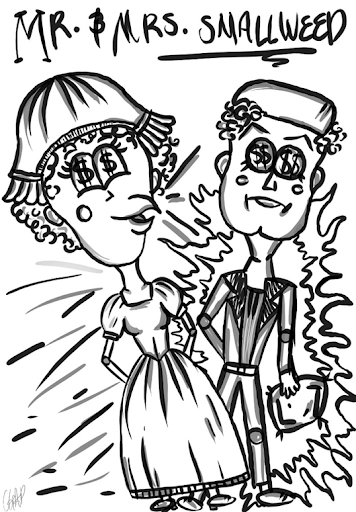
It was gratifying when students realized that these three types of responses often overlap or intersect: for example, one student drew a caricature sketch of the Smallweeds (a creative response), which she prefaced by discussing the history of caricature and comedy in visual art (contextualizing her creative response), and which then led to a class discussion of Dickens’s style of portraying characters in the novel (a critical response).
Students’ written responses often identified points of intersection between our novel, podcast, and television narrative. Inspired by a conversation about the lack of positive queer representation in Broadchurch, one student wrote a “fixit” fanfic to provide an alternate ending for Bleak House in which Richard becomes romantically involved with Woodcourt and Esther pairs with Ada. In this revised ending, Jo survives his illness and is co-parented by Esther and Ada, and Woodcourt supports Richard’s growing career as a writer. Another student’s Pinterest-style “mood board” illustrating Beth’s grief over Danny’s death in Broadchurch led to excellent discussion of Lady Dedlock’s and Jenny’s bereavement, along with reflection on social pressures to be a “good mother” or a “good woman” in the nineteenth and the twenty-first centuries.
“What connexion can there be,” Dickens’s third-person narrator muses, “between the place in Lincolnshire, the house in town, the Mercury in powder, and the whereabout of Jo the outlaw with the broom, who had that distant ray of light upon him when he swept the churchyard-step?” (256). Inviting students to write smaller assignments more regularly (mimicking the style of serial publication) helps them make connections between Dickens’s characters and settings, between serialized narratives past and present, and between the stories we consume and the real world.
Assignment Instructions
Reading Responses or Reflections
On a regular and rotating basis, you will record your evolving thoughts about the serial parts of the novel as our class discusses them together. These responses will be due at the start of the week and will be used as starting points for our in-class discussion sessions. Since you will be composing these responses before finishing the entire novel, these responses might raise more questions than they answer, and you should feel free to speculate on the direction the story might take as it unfolds. Length of responses will vary, especially the creative responses, but each response should be roughly 500-750 words in length. Cumulatively, reading responses should add up to the length of a term paper.
[NB for educators: the second critical option described below may instead be used as an in-class exercise to help familiarize students with Dickens’s working notes for the novel and the Dickens Notes website.]
You will cycle through three types of reading response:
-
Critical or analytical: In this type of response, you will demonstrate your analytical “close reading skills,” submitting a short piece of writing, responding to a passage, character, or theme from the assigned reading for the week. If you are not sure what to write about for your critical response, you may use Dickens’s working notes for the serial part(s) discussed this week to help you determine a focus for your close reading.
-
Alternatively, instead of writing a close reading in paragraph form, write your personal notes on this serial number in the style of Dickens’s working notes for the novel. Fold a piece of paper in half: on one side, record plot points or characters that are found in each chapter. On the other half of the paper, record your responses and speculations: how do you respond to these characters and events? What do you think will happen next? Try using different colors of pen to record different kinds of responses, just as Dickens did in his own working notes. You could also experiment with your own “counterfactual” notes. What title would you give one of Dickens’s chapters, for example?
-
Creative: Adapt this section of the story in a different artistic medium: draw an illustration, write a piece of fanfiction, create a blackout poem, compile a photo essay or collage that responds to the reading assigned for the week. This is not an exhaustive list: be creative and think outside the box! If you’re looking for inspiration, you may check out the ideas Dickens brainstormed in his working notes. For example, did Dickens write down multiple possible names for a single character or sketch a storyline that he didn’t include in the novel? Use that abandoned idea or discarded character as inspiration for your creative response.
-
Contextual: Report and reflect on paratextual material that you discover in the original serialized numbers of the novel or outside sources that are relevant to the events in this serial part: you might focus on an illustration, an advertisement, or even a theatrical adaptation that came out before the novel finished serialization. You may also choose to reflect on biographical or historical contexts: what was going on in Dickens’s personal life at the time? What political or historical events were happening in the month this serial part was published, and how might they be relevant to the events of the novel? The editorial annotations on the Dickens Notes website often include references to Dickens’s manuscripts, letters, and reviews of his work. These annotations may be used as a helpful resource for your contextual responses. Please include a works cited page in MLA format to acknowledge all sources you used.
Works Cited
- Baldi, Brian, and Cynthia Mejia. “Utilizing Slow Reading Techniques to Promote Deep Learning.” International Journal for the Scholarship of Teaching and Learning, vol. 17, no. 1, 2023, pp. 1-11.
- Chibnall, Chris. Broadchurch: The Complete First Season. Kudos in association with Imaginary Friends Productions Ltd., 2013.
- Dickens, Charles. Bleak House, edited by Nicola Bradbury. Penguin, 1996.
- Horowitch, Rose. “The Elite College Students Who Can’t Read Books,” The Atlantic, 1 October 2024.
- Hughes, Linda K., and Michael Lund, “Serial Reading,” Teaching Nineteenth-Century Fiction, edited by Andrew Maunder and Jennifer Phegley, Palgrave Macmillan, 2010.
- Koenig, Sarah. Serial, season 1. WBEZ, 2014. https://serialpodcast.org/season-one
- Winyard, Ben. “‘May we Meet again’: Rereading the Dickensian Serial in the Digital Age.” 19: Interdisciplinary Studies in the Long Nineteenth Century, no. 21, 2015.