Keeping “Reading Notes” for a Novel
An assignment by Adam Grener
How to cite this page (MLA): Grener, Adam. “Keeping ‘Reading Notes’ for a Novel.” Dickens Notes. Anna Gibson and Adam Grener, dirs. 2026. Web. http://dickensnotes.org/usage/teaching/assignments-grener
Overview
For the past few years, I have been teaching an upper-level Victorian literature course with a focus on seriality. The primary reading for the course is Bleak House, which we read by covering two installments each week over the first ten weeks of the twelve-week term. We also think about serial form more capaciously, reading sonnet sequences like E. B. Browning’s Sonnets from the Portuguese and Tennyson’s In Memoriam through the framework of seriality, as well as stories from the Sherlock Holmes series. While seriality is the overarching framework for the course—even Darwin’s theory of evolution and Marx’s analysis of capitalism become examples of serial thinking—I also cover key topics like urbanization, gender, colonialism, and disability by linking other short readings and excerpts to relevant installments in Bleak House.
One of my main goals in this course is simply to get students to read—and hopefully enjoy—Bleak House, and to that end one of the major assignments in the course requires students to keep a “Serial Reading Journal.” They are expected to keep a journal through the course and make entries most (if not all) weeks. I ask them to adopt some kind of framework for the journal—a structure that is iterated serially, though they are free to change tack during the term if their chosen approach becomes stale. The primary format I offer students for structuring their journal entries is to create “reading notes” for the novel, which I describe in more detail here. But students have devised all kinds of creative and intelligent ways of engaging with the novel on a week-by-week basis, from creating alternative illustrations or scripting scenes for a serial television drama, to crafting memes, writing their own short serial fictions, and even hand-stitching journals. The rubric that accompanies the assignment delineates the three key criteria I use to assess their journals: (1) serial thinking (how consistent they are); (2) creativity & individual voice (how well they evidence an embodied experience of and response to the novel); and (3) critical insight (about the text, but also in the form of connections between readings and the world beyond).
Their reading journals also support the larger philosophy behind the course, which I present to them as “reading in community.” I am not sure that reading the novel “in its original installments” or “as its first readers experienced it” appeals much to my students, but this course has helped me appreciate how much it helps to frame learning as a communal experience. And most students need the full duration of the course to read Bleak House, so reading the novel in installments makes it a manageable, if still daunting, task. They come to class excited to talk about new developments from the prior week; some groups even self-organize and meet outside of class to read portions out-loud (or silently) together. Many students stick rigidly to our reading schedule and refuse to expose themselves to future developments by looking online, and those who read ahead or consult outside material respect the larger conceit of the course: that each week we only have as much of the novel as Dickens himself had written to that point. The students’ journals are, in the first instance, generative classroom tools for creating discussion, as they come to class each week with whatever notes or ideas they’ve entered.
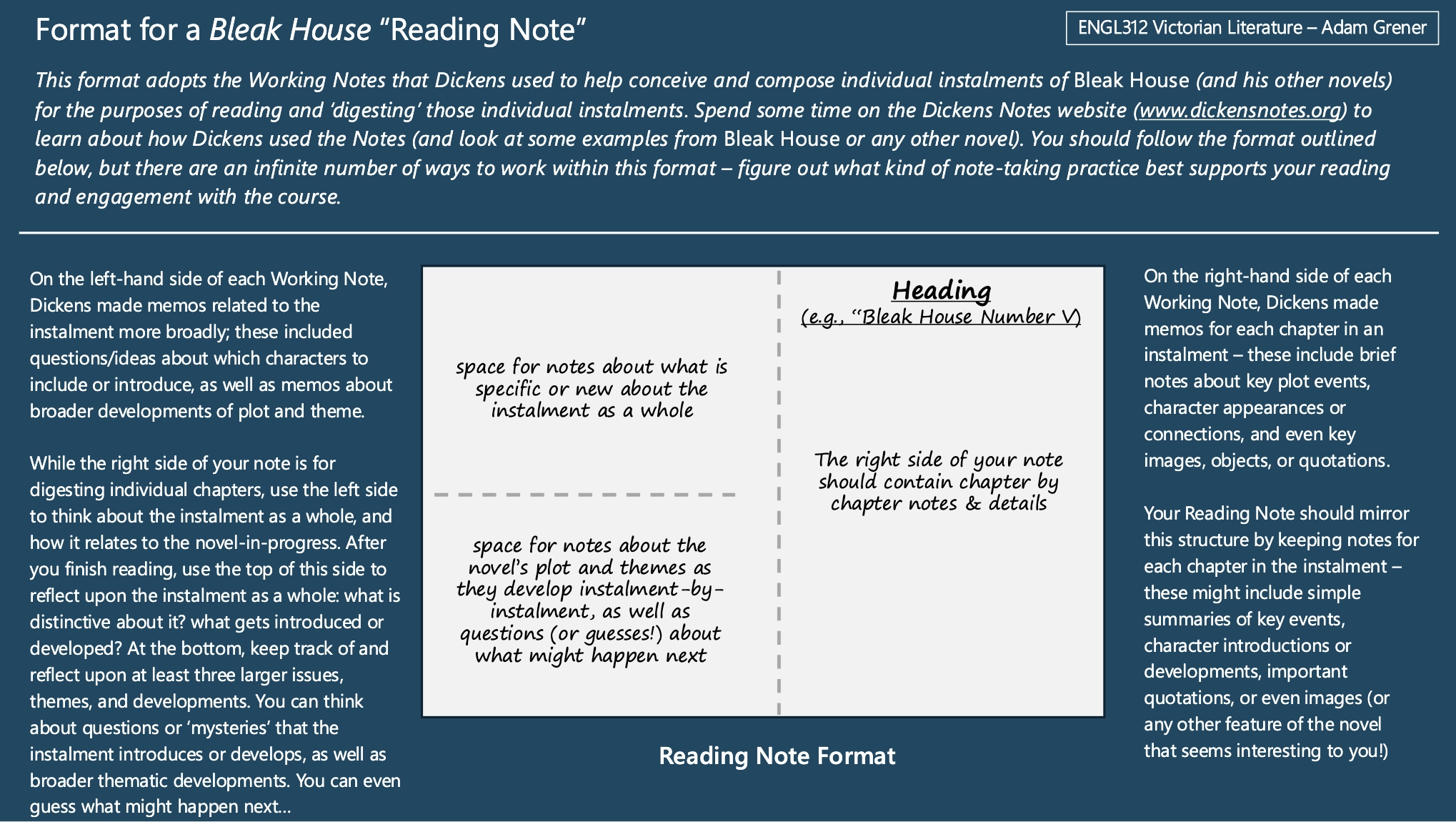
The “reading note” format for the journal invites students to adapt the format of Dickens’s working notes: if the working notes capture the process of Dickens’s creation of each installment, then their reading notes capture their individual experience of each installment. I spend time in the first week of the course introducing the working notes, explaining what they help us to see about Dickens’s approach to serial writing, namely, that it is systematic as well as improvisational. The working notes capture this in a very basic way: each working note has the same format, with generative “mems” and queries on the left side, and chapter notes on the right side. But each set of working notes, and each individual note, is also of course entirely unique. Understanding and adopting this format as a reader offers students a way to approach Bleak House with some kind of “‘system’.” As the accompanying handout explains, they use the right-hand side of their reading note to keep track of details chapter-by-chapter; they are then invited to use the left side to reflect upon the installment as its own individual unit, and to consider its role within the novel-in-progress, keeping track of longer-term developments, questions, and even hypotheses about what might happen next.
Although I spend a good amount of time introducing students to Dickens’s working notes, I don’t require them to engage with the Bleak House working notes as we read, since they contain spoilers for future installments. Many students do engage with the notes on the Dickens Notes website, and become fascinated by the constraints Dickens worked within while writing serially. These are temporal and spatial constraints of the monthly installment, but also the constraints of having to commit to the details of plot and storyworld already present in prior installments, while continuing to develop the novel’s multiple plots (and viewpoints). Some students create reading notes that are a fairly straightforward distillation of each installment, but even here they help to structure—and also document—regular engagement with the text. More frequently, adopting a consistent practice helps students to notice patterns and “connexions” they would have otherwise missed, and to become embroiled in the workings of the novel as something being created, and re-created in their ongoing experience of it. While there is only one set of working notes for Bleak House, each set of “reading notes” is entirely unique—a record of how one student has experienced the novel. This helps them to better understand how their individual experience of a literary text is something to pay attention to and value, as well as something to share with other readers around them.
Assignment Instructions
Serial Reading Journal Guidelines
As we read Bleak House in its original serial instalments, you will keep a journal (or equivalent) that facilitates and reflects your week-by-week engagement with the course. You are being asked to keep a physical journal—this can be a notebook, another bound journal, or one that you create/craft. If you feel you need to keep your journal in electronic format, please speak to me to get permission to do so. Your journal should reflect your on-going (week-by-week) engagement with Bleak House and the course; you should aim to add to your journal every week, though you need not have an entry in absolutely every week for “excellent performance.”
Overall, your journal should follow these guidelines:
-
Your journal should contain a minimum of 8 distinct entries and should be a minimum of 2500 words or equivalent (i.e., most weeks you should be writing 250-300 words as a minimum entry, either in the form of a paragraph, notes, or equivalent ways of engaging with the reading and course content); please date all entries and link to the relevant week or installments. Your final entry should be a reflection on the journal as an exercise;
-
You are strongly encouraged to harness this assignment to support your engagement with Bleak House in whatever way would be most helpful for your learning; your journal should be reflection of how your mind works and engages with the course reading and material;
-
Your journal must NOT be composed entirely of plot summary. However, summarizing each instalment can be part of your journal (especially if you adopt some structured strategy like the “Reading Notes” suggested below).
-
Below are some possible formats to adopt or use, though you are welcome to develop your approaches to the assignment.
Journal Format Options
-
Create your own “Reading Notes” for Bleak House: In the same way that Dickens used the working notes as a format to approach composing the novel in serial installments, you can keep a comparable “Reading Note” for each installment (see attached for a sample format for a “Reading Note” that mirrors Dickens’s working notes);
-
Analyse Dickens’s Working Notes: As part of our reading, you will have the opportunity to explore the working notes Dickens kept as he wrote Bleak House serially (please note that the working notes contain some spoilers!). You can analyse each working note alongside the installment as you read. You can generate your own annotations (I can supply you with PDFs), or you can simply view transcriptions of the working notes online and document your observations and analysis in your journal;
-
Passage Analysis: choose a passage from each installment of Bleak House and analyse it. You may cut-and-paste your chosen passage into your journal and annotate it, or simply identify the passage at the start of your entry and then perform a short (or long!) analysis of it;
-
Weekly Reflection: you can structure your journal around a weekly reflection. This could be a way of consolidating your learning each week – it should involve reflection on your learning in the course (which includes but is not limited to your reading of Bleak House); it should therefore include consideration of other readings, lecture content, and workshop discussions;
-
Think and Create with any dimension of Seriality: be creative! There are different aspects of Bleak House’s serial publication (e.g., each installment contains two illustrations that could be analysed, or you could create alternative illustrations for installments). And there are many ways to engage with serial processes: in a basic sense, serial process is about working within the same constraints (of both format and time). Make a soundtrack for each week!? Generate 5 questions each week; force yourself to summarise each chapter in some set structure or word-count, etc. etc. Think about how your mind works, and how you engage with the reading, and adopt practices that seem interesting and supportive for you.